Wednesday, April 19, 2006
Practicing While Away
I'm debating how best I might stay practiced while away from home. I need something that is portable and will not be annoying in a dorm room setting. Maybe a headphone amp? Maybe just playing unplugged?

Saturday, April 01, 2006
Straplocks
I picked up a set of the Schaller units on Thursday and I plan to try them out on my fretless. I suppose the fact that I refinished that one has made it my de facto tinkering bass. If I want to try any new hardware or whatever, that's where I do that.
Wednesday, March 22, 2006
Michael Manring on Loopers
Via Talkbass, I found out about this article on loopers by Michael Manring. When I first picked up my DL4 I sort of thought of the loop function as a sort of novelty. I didn't see how I could use it all that much. (It's too tricky to loop things just right in a live setting, and in recording, I could just use the recording software to loop things, right?) Well, this article has some practical applications for loopers as a practice tool, it sounds interesting, so I think I may try to put some of this into practice.
Monday, March 20, 2006
Favourite Bassists - In a Band Setting
Everyone knows who you put on a list of the best bass players, Jaco, Wooten, Michael Manring, Steve Bailey. Those players who push the instrument to its limits, especially in solos or other settings designed to showcase the considerable talent required to play the way that they do. Let's not take anything away from these bassists, they are geniuses, full stop. But for most of us, playing this instrument is usually all about laying a foundation. You lock in with the drums, you make a groove, and there is almost never a solo spot for you.
In light of all this, I thought it would be interesting to create a list of the top players that reflect the reality of a lot of bassists out there. My parameters were to look for players who had made a name for themselves in a band context. I figure that this is a practical list, since I find it more likely that I'll be trying to spice up my parts in a band setting than anything else. Other than that, this really reflects my own biases. If your favourite isn't on the list, don't take it personally. In no particular order:
Peter Hook - In Hook's work with both Joy Division and New Order, the bass always stands out. He's sort of in the tradition of John Entwistle, using the bass to create lead parts without dominating the song. Hook is also not afraid to explore different bass tones, there were some really gritty ones with Joy Division.
Duff McKagan - I suppose not a lot of people would have expected the GNR/Velvet Revolver bassist on a list composed by me, but Duff is a solid player who can create interesting counterpoints to Slash's guitar leads (see the Paradise City outro).
Mike Mills - I think that Mills, and actually R.E.M. as a whole don't get nearly the credit they deserve. R.E.M. has got to be the post-punk jangly indie archetype (or is it The Smiths, maybe both). Anyway, Mills is always using these tasteful little fills and I don't think he gets the credit he deserves because he is so subtle often.
Matt Freeman - He is head-and-shoulders above every other punk bassist of his generation. He has virtuoso technical chops, but other than Maxwell Murder, there are no real Matt Freeman solos to speak of. All the same, he doesn't need a solo to put the lie to the notion that punk bass is just eighth-note roots all the time.
John Entwistle - If there is one player who was the archetype for innovating in a rock and roll band context, I'd say that The Ox is it. This man was the force behind roundwound bass strings. Think about that for a minute. More than likely you owe something of the design of your stings (unless you only put flats on your bass) to him. Entwistle saw the tonal possibilities of the bass guitar and gave it a key push out of the mold of sounding like uprights.
In light of all this, I thought it would be interesting to create a list of the top players that reflect the reality of a lot of bassists out there. My parameters were to look for players who had made a name for themselves in a band context. I figure that this is a practical list, since I find it more likely that I'll be trying to spice up my parts in a band setting than anything else. Other than that, this really reflects my own biases. If your favourite isn't on the list, don't take it personally. In no particular order:
Peter Hook - In Hook's work with both Joy Division and New Order, the bass always stands out. He's sort of in the tradition of John Entwistle, using the bass to create lead parts without dominating the song. Hook is also not afraid to explore different bass tones, there were some really gritty ones with Joy Division.
Duff McKagan - I suppose not a lot of people would have expected the GNR/Velvet Revolver bassist on a list composed by me, but Duff is a solid player who can create interesting counterpoints to Slash's guitar leads (see the Paradise City outro).
Mike Mills - I think that Mills, and actually R.E.M. as a whole don't get nearly the credit they deserve. R.E.M. has got to be the post-punk jangly indie archetype (or is it The Smiths, maybe both). Anyway, Mills is always using these tasteful little fills and I don't think he gets the credit he deserves because he is so subtle often.
Matt Freeman - He is head-and-shoulders above every other punk bassist of his generation. He has virtuoso technical chops, but other than Maxwell Murder, there are no real Matt Freeman solos to speak of. All the same, he doesn't need a solo to put the lie to the notion that punk bass is just eighth-note roots all the time.
John Entwistle - If there is one player who was the archetype for innovating in a rock and roll band context, I'd say that The Ox is it. This man was the force behind roundwound bass strings. Think about that for a minute. More than likely you owe something of the design of your stings (unless you only put flats on your bass) to him. Entwistle saw the tonal possibilities of the bass guitar and gave it a key push out of the mold of sounding like uprights.
Wednesday, March 15, 2006
Jackson Music Report
Yesterday I made it out to Jackson Music Centre on Grand Island (as promised last week). They had a huge selection of guitars, but not all that much in the bass department. They did have a Fender Jaguar bass. I had not seen that one in person before, so that was cool. All in all the bass selection was utterly dominated by Fender, with maybe 4 Korean-made Spectors, some Ibanez Soundgears, a couple of the newer Tobias basses, and maybe a couple Epiphones. Similarly the bass amp selection was nothing that I couldn't see Long & McQuade offering at the Bloor location.
I did manage to try out one cool pedal, the MXR M-80. I had seen these around a few places, but yesterday I finally got one out and put it through its paces. It actually came off as potentially a very useful pedal, in the right context. Certainly it has a range of very usable distortion tones, this is due, in no small part, to the fact that there is a blend knob. It's very easy, in my experience to lose the bass in the mix entirely without some kind of clean tone blended in.
Other than that, I learned that some stuff isn't appreciably cheaper on this side of the border. Strings, however, are a lot a cheaper in certain cases. They also had the ones I like, DR Sunbeams. So I suppose that it may be worth it to at least stock up on those down here.
I did manage to try out one cool pedal, the MXR M-80. I had seen these around a few places, but yesterday I finally got one out and put it through its paces. It actually came off as potentially a very useful pedal, in the right context. Certainly it has a range of very usable distortion tones, this is due, in no small part, to the fact that there is a blend knob. It's very easy, in my experience to lose the bass in the mix entirely without some kind of clean tone blended in.
Other than that, I learned that some stuff isn't appreciably cheaper on this side of the border. Strings, however, are a lot a cheaper in certain cases. They also had the ones I like, DR Sunbeams. So I suppose that it may be worth it to at least stock up on those down here.
Another Bass Blog
This blog was created by another Talkbass member to be a clearinghouse for information on short scale basses. So if that's your thing, check out The Short Scale Bass Blog. It's late and I'm tired, but I'll probably put it in the "links" section when I get a chance.
Wednesday, March 08, 2006
Exploring
Well, now that I spend half my time in Western New York, I might as well find out what this fine region has to offer in the way of music stores. To that end, next week I'll be off to Jackson Music Centre to find out. Since I've had them recommended both in conversation with locals and online at Talkbass, I figure they are worth a shot. I will go in with an open mind and try to ignore the somewhat-lacking-in-content website.
Wednesday, March 01, 2006
What the Roan isn't telling you:
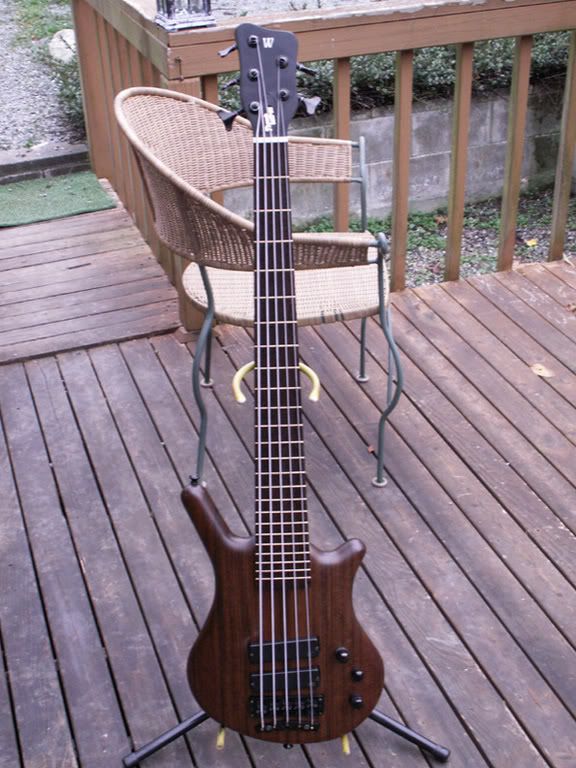
Jay has picked up a Warwick Thumb 5-string and an SWR head in the past week. Since he must be ashamed that he couldn't snag a busted-up Precision with flatwounds and some pics wedged under the pickguard, it's left to me to tell you about it.
Pictured on the upper left is the Thumb 5 that will soon belong to the Roan. This specimen includes the seldom-seen soapbars as well as the wide string-spacing. I'm sure this bass will provide Jay with hours of slappity fun.
In addition, the Roan seems set to acquire an SWR SM-400 head. This is a classic from the SWR lineup and will pair very well with the Thumb I imagine. The question that remains though is what kind of cabinet will be paired with the SM-400. What configuration will it be? 2x10? 4x10? 1x15? 1x18? Horn or no horn? Will it be an SWR to match the head, or maybe something else? Aguilar? Bag End? Euphonic Audio? Bergantino? Eden? Who knows?
Nonetheless, exciting times for the Roan...
Edit: It now appears that the Roan has selected an SWR 4X10 Goliath cabinet to go with his new head. There you have it, in a few weeks the Roan has gone from one Mexican Precision Special to a full gigable rig that would be acceptable in a wide range of semi-pro and pro settings. Way to go, Roan!
Saturday, November 26, 2005
Vintage Versus Modern
I was in Songbird today checking out some stuff. They had a super old (1960s) Traynor Bass Mate. This this has only one volume and one tone knob, it's speaker is of the type that one might use on a PA system and the back of the cabinet wasn't even sealed. In other words, I suppose it's what you might expect barely a decade after the first viable electric bass design came to market. The effect of this design, combined with the maple-fretboard Precision I played through it was one of a lot of treble and high-mids. I only had the tone control at 50% but that sound was incredibly pronounced. But what a sound it was. There is nothing else quite like this amp's tone - the wonderful tubey high growl. It is of course impractical by today's standards. Insufficient equalisation, no XLR output, not enough power (maybe 85 watts, tops), and it was kind of bulky for all of that too.
But listen to it. Wow. Nothing today sounds like that. No amount of twiddling with a graphic EQ will give you that kind of character in your tone. Nothing modern can ape that sound.
Don't get me wrong, modern amps are wonderful in so many respects. They have all the appropriate inputs and outputs. You can set up the EQ for just about any bass in any situation. They have gobs of power - and often in small packages. Companies like Markbass are doing genius things with super-powerful 1x12 combos. Lighter and more powerful amps are coming in all the time. They generate a huge presence from a tiny box, wonders of technology they are.
But, but, listen to that Bass Mate. It does one thing, but that one thing is sooooo magnificent, sooooo unique.
Vintage?
Modern?
You tell me.
But listen to it. Wow. Nothing today sounds like that. No amount of twiddling with a graphic EQ will give you that kind of character in your tone. Nothing modern can ape that sound.
Don't get me wrong, modern amps are wonderful in so many respects. They have all the appropriate inputs and outputs. You can set up the EQ for just about any bass in any situation. They have gobs of power - and often in small packages. Companies like Markbass are doing genius things with super-powerful 1x12 combos. Lighter and more powerful amps are coming in all the time. They generate a huge presence from a tiny box, wonders of technology they are.
But, but, listen to that Bass Mate. It does one thing, but that one thing is sooooo magnificent, sooooo unique.
Vintage?
Modern?
You tell me.
Friday, October 28, 2005
One That Got Away
I had been eyeing this used Stingray 5 at Long & McQuade for a while. Today, before I had a chance to do anything about it, I found out it had been sold. It sounded nice and I think it was a good deal. What I've noticed though is that, if you wait, there will be others. There are a number of great gear deals that I've seen but missed out on ultimately. The only one I still wish I had bought was a 1970s Precision with a Jazz neck. Since it was a Frankenbass it was only $700 - way less than either a Precision or a Jazz from that period sells for today. I would really have like to have that bass. It was cheap because it was useless to collectors, but it had a great sound and it was a joy to play. That SR5 was a nice bass, but nothing to this other one.
Wednesday, October 19, 2005
My Project Bass
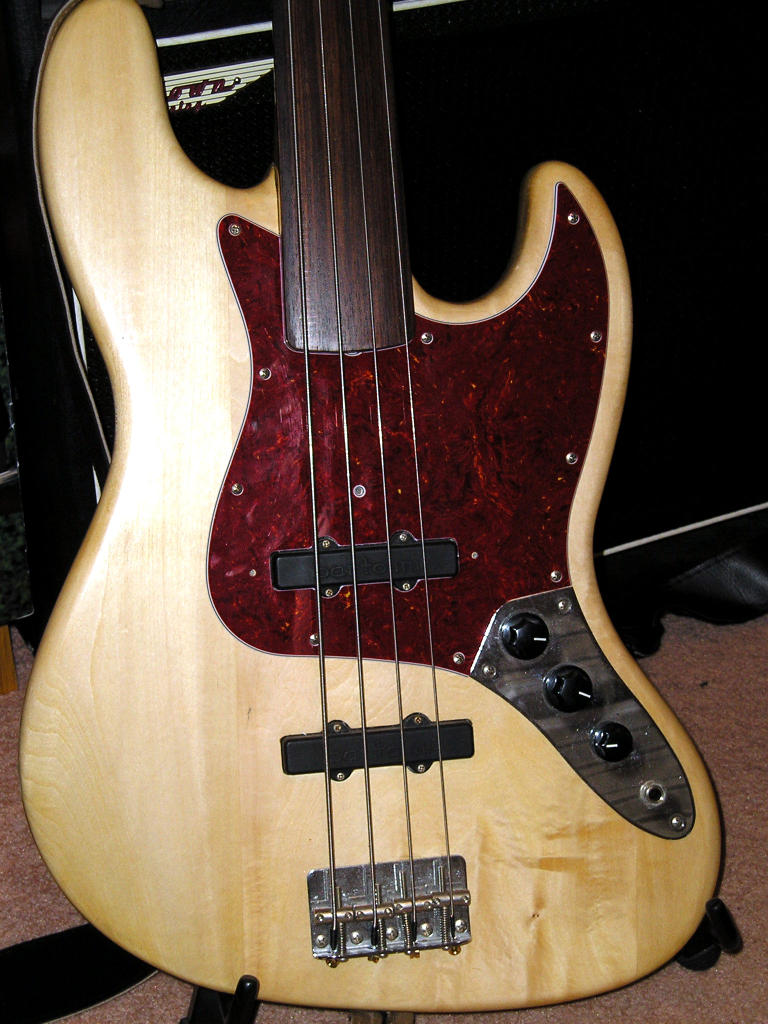
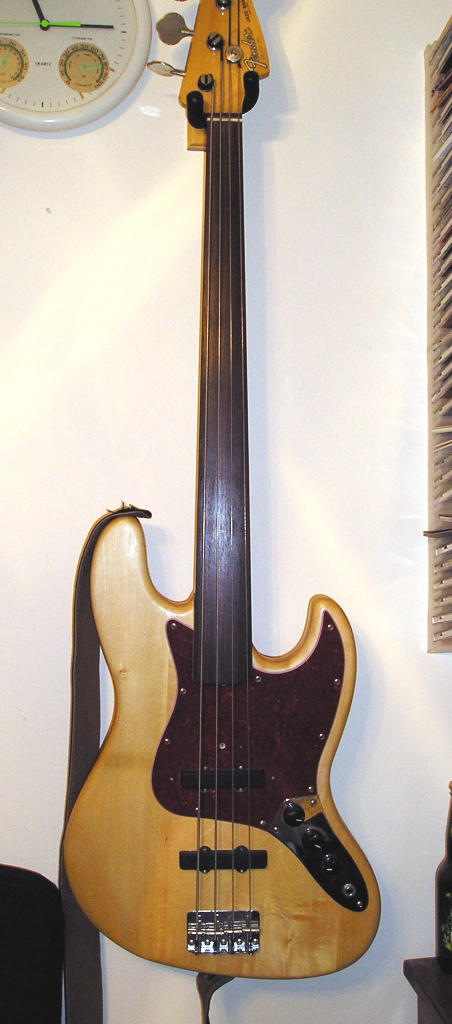
I know I've mentioned this before, but to my knowledge, I've never shared any pictorals. The back story is that this is an '89 Fender Jazz fretless that, when I bought it was stock except for a white pearloid pickguard that I believe was aftermarket. The black finish on the body was ruined by some unknown solvent-animal hair combination (I should have taken "before" pictures, it was as bad as it sounds). Anyway, I stripped off the paint and refinished it with gunstock oil. I chose gunstock oil because it is easy to apply and therefore ideal for beginners such as myself. I was able to pick up some nice pickups and, recently, a pickguard from Talkbass. That's the story, now here are the pics:
Just the body:
And the whole shebang:

Just the body:
And the whole shebang:
Friday, October 14, 2005
Four versus Five
All the basses I own are four-strings. I don't own a lot of basses, but I do own several. From time to time either myself or someone else will wonder why I don't have at least one five-string. I have seen many posts on Talkbass where people try to argue objectively for anything from four strings to seven strings and beyond. I always say that I use fours because typically that's what works for the music I play. If I played prog rock or fusion, that would change maybe. All the same I wonder sometimes about a five.
This feeling strikes me especially when playing in D or Eb, for obvious reasons. But outside of that, I wonder what I'm missing. The thing that appeals to me is that tonally, I like the sound of notes played further up the neck. Playing a low E at the fifth, F# at the 7th, that's what appeals to me too.
This feeling strikes me especially when playing in D or Eb, for obvious reasons. But outside of that, I wonder what I'm missing. The thing that appeals to me is that tonally, I like the sound of notes played further up the neck. Playing a low E at the fifth, F# at the 7th, that's what appeals to me too.
Tuesday, October 04, 2005
Not Using a Pick is Self-Limiting
I'm sorry to read that The Roan is fearful of exploring new sonic experiences. That's right, it seems that there is a fundamental fear of a couple different things here. One, that Jay might somehow be compared to Mark Hoppus. I'm not sure how exactly that would transpire, because I don't recall anyone asking me whether I was hanging out with Mark Hoppus when I was, in fact, hanging out with Jay.
The other fear seems to be that bass "will remain stuck in the eyes of most people as the guitars[sic] fat brother" if one plays it with a pick. Unfortunately, if we were worried about this then I guess fingerstyle playing is out too, isn't it Django? The reality is that both guitar and bass have been, and continue to be, played with a variety of techniques. The bass guitar was originally built by Leo Fender (and others) as something that would be part of the electric guitar family of instruments. Why do you think Fender put pickguards on the Precision right from the start in 1951? He assumed that pick-playing was a possibility. Playing with a pick was not invented in 1974 by DeeDee Ramone. Think of the broader family of stringed instruments. Do violinists say to cellists, or double bassists, "Only we are to play arco!" No. That would be insane. There is nothing wrong with multiple instruments being played with a similar technique.
As to pick playing not cutting through, I have never had that problem. I find it very easy to switch from pick to fingerstyle and back. Jay points out that the tone of a pick can imitated by a variety of pedals or equalizer changes. While I don't concede that these necessarily replicated a proper pic tone, even if they did, all of these options would be more expensive than a $1 pick. MXR micro amp? $100+. Boss GEB-7? Maybe $80 used if you look around. Even if you have an amp with a footswitchable EQ, you'd need to buy the footswitch to do that. Even that would be another $25-40 even used. So even if you thought you had the sound, you would have to spend a lot of money.
In short, it's time to end the anti-pick prejudice - it's self-limiting.
The other fear seems to be that bass "will remain stuck in the eyes of most people as the guitars[sic] fat brother" if one plays it with a pick. Unfortunately, if we were worried about this then I guess fingerstyle playing is out too, isn't it Django?
 The reality is that both guitar and bass have been, and continue to be, played with a variety of techniques. The bass guitar was originally built by Leo Fender (and others) as something that would be part of the electric guitar family of instruments. Why do you think Fender put pickguards on the Precision right from the start in 1951? He assumed that pick-playing was a possibility. Playing with a pick was not invented in 1974 by DeeDee Ramone. Think of the broader family of stringed instruments. Do violinists say to cellists, or double bassists, "Only we are to play arco!" No. That would be insane. There is nothing wrong with multiple instruments being played with a similar technique.
As to pick playing not cutting through, I have never had that problem. I find it very easy to switch from pick to fingerstyle and back. Jay points out that the tone of a pick can imitated by a variety of pedals or equalizer changes. While I don't concede that these necessarily replicated a proper pic tone, even if they did, all of these options would be more expensive than a $1 pick. MXR micro amp? $100+. Boss GEB-7? Maybe $80 used if you look around. Even if you have an amp with a footswitchable EQ, you'd need to buy the footswitch to do that. Even that would be another $25-40 even used. So even if you thought you had the sound, you would have to spend a lot of money.
In short, it's time to end the anti-pick prejudice - it's self-limiting.
Saturday, October 01, 2005
Pro et Contra 1: Slap Bass is Overrated
Sure The Roan and I share this nice little blog. But that sure doesn't mean that we agree on everything. So we were talking about it, and we decided it was time to present our opinions on issues out there in the world of bass playing. To start, I will explain why slap is overrated wankery and Jay will offer a rebuttal (I hope). Here we go:
There was a picture in the paper the other day of some guy who had run a marathon while juggling. This is something that undoubtedly require many hours or practice and preparation. The man who did this must have had all kinds of coordination as well as endurance. In short, it was impressive that he could do this sort of thing at all.
On the other hand, I don't think I'd very much enjoy watching some guy juggle and run for three hours. A couple minutes of it would be interesting viewing, but beyond that, I wouldn't need to see the whole marathon. And that's how I feel about slap. Like juggling while running a marathon, slap bass is an impressive accomplishment - but is either one worthwhile beyond the technical precision and the novelty? Many slap players have spent hours mastering the technique. Hearing a lightning fast double-thumb line, the listener has to respect the player. All the same though, I have to suggest that slap bass is not all it's cracked up to be by its proponents.
Slap bass gets lost in the mix very easily. It seems that to do slap and be heard, one needs to employ some kind of boost. That's the first problem, when you're showing off to grade tens in Long & McQuade, it may sound cool. But in a band setting, it's just getting lost. Remember, bass playing is not a competitive sport, it's part of a creative process. If you want to serve that creative process, you'd better be prepared to do what's needed for the music. It doesn't seem like slapping is needed in actual songs quite as much as it is needed for showing off in music stores.
Now what about funk? Or jazz fusion? Yes, more so than in other genres you can justify slapping in these two. At the same time though, there are all kinds of examples of great fingerstyle players in both genres. How often is a player going use this technique in other genres? There are all kinds of things that might make for a better player that might be worth trying. Again, music is an art form, and as a musician, your first job is to participate in creating art. Often times though, the slap riff is more of an incongruous intrusion than a tasteful addition.
In short, I think slapping is an interesting novelty. A bassist can pull out something like Higher Ground and the band can have fun jamming along. But, excepting fusion (which, the last time I checked, is not the most popular genre) how often is this technique really used? Not very often at all it seems. The time spent learning how to master slap might better be spent studying things like theory to learn how to create something other than a percussive assault.
There was a picture in the paper the other day of some guy who had run a marathon while juggling. This is something that undoubtedly require many hours or practice and preparation. The man who did this must have had all kinds of coordination as well as endurance. In short, it was impressive that he could do this sort of thing at all.
On the other hand, I don't think I'd very much enjoy watching some guy juggle and run for three hours. A couple minutes of it would be interesting viewing, but beyond that, I wouldn't need to see the whole marathon. And that's how I feel about slap. Like juggling while running a marathon, slap bass is an impressive accomplishment - but is either one worthwhile beyond the technical precision and the novelty? Many slap players have spent hours mastering the technique. Hearing a lightning fast double-thumb line, the listener has to respect the player. All the same though, I have to suggest that slap bass is not all it's cracked up to be by its proponents.
Slap bass gets lost in the mix very easily. It seems that to do slap and be heard, one needs to employ some kind of boost. That's the first problem, when you're showing off to grade tens in Long & McQuade, it may sound cool. But in a band setting, it's just getting lost. Remember, bass playing is not a competitive sport, it's part of a creative process. If you want to serve that creative process, you'd better be prepared to do what's needed for the music. It doesn't seem like slapping is needed in actual songs quite as much as it is needed for showing off in music stores.
Now what about funk? Or jazz fusion? Yes, more so than in other genres you can justify slapping in these two. At the same time though, there are all kinds of examples of great fingerstyle players in both genres. How often is a player going use this technique in other genres? There are all kinds of things that might make for a better player that might be worth trying. Again, music is an art form, and as a musician, your first job is to participate in creating art. Often times though, the slap riff is more of an incongruous intrusion than a tasteful addition.
In short, I think slapping is an interesting novelty. A bassist can pull out something like Higher Ground and the band can have fun jamming along. But, excepting fusion (which, the last time I checked, is not the most popular genre) how often is this technique really used? Not very often at all it seems. The time spent learning how to master slap might better be spent studying things like theory to learn how to create something other than a percussive assault.
Monday, September 26, 2005
Last Night
Nothing beats playing bass when you have a solid drummer, and two solid drummers, that's what I had last night.
Sunday, September 18, 2005
Acoustic Bass Guitars
I was at the Twelfth Fret on Saturday and they had a Larrivee acoustic bass guitar (ABG). I tried it out and I must say that it had an okay sound. That's the thing with ABGs though, the best of them can generate a decent sound, but nothing spectacular to my ears. I don't really see an opportunity to use in one at most gigs where I'd regularly use an electric bass. The suggestion I've had is that they might be good for acoustic-type gigs, but tonally, I think my fretless works best for that. I suppose they look better for acoustic gigs, but that's a silly reason to get a particular instrument. You might wish to use one in some kind of setting where everyone is unplugged, but an unplugged acoustic guitar will drown out most unplugged acoustic basses.
Additionally, you have to be far more worried about the conditions to which an ABG is subjected. If it's got a solid top, you'd better be mindful of temperature and humidity. It's also bulkier. And being hollow, it's just asking for feedback when you (inevitably) plug it in.
So while this Larrivee I saw is undoubtedly a nice bass, I'm not sure that I could find a reason to have such a beast in my collection.
Additionally, you have to be far more worried about the conditions to which an ABG is subjected. If it's got a solid top, you'd better be mindful of temperature and humidity. It's also bulkier. And being hollow, it's just asking for feedback when you (inevitably) plug it in.
So while this Larrivee I saw is undoubtedly a nice bass, I'm not sure that I could find a reason to have such a beast in my collection.
Saturday, September 10, 2005
Another Shopping Trip
After going downtown on some unrelated errands I decided to stroll down to Songbird and look at some of the stuff they had there. It was a good choice because, despite them not have much in the bass department that tickled my fancy for some time, today they had some good selections. The first thing that caught my eye was a Les Godfrey Dragonetti. It had a nice sound, almost like a Precision, but with the pickup closer to the bridge (who knows, maybe this is what the Precision Elites sounded like with both pickups on). They also had a USA Lakland 55-94 fretless. It was cherry burst and unlined, a good look if you ask me. The third bass that caught my eye was a bit of a surprise, it was a Peavey Cirrus 5. I had tried a Cirrus 5 on one previous occasion and was somewhat underwhelmed by it. The pickups were kind of dull and uninspired and overall it left me thinking, "meh." That said, I figured I might as well give this one a go too. I was surprised, it had a nice, fairly modern growl. It was something between a contemporary Jazz bass and a Stingray, not a bad sound in my estimation. It was voiced in such a way that everything was nice and clear, thus making chords, double-stops, and harmonics all joys to play. Anyway, right now I hope that all these basses will cancel each other out and I'll end up not wanting any of them... So I can afford school, heh.
Tuesday, August 30, 2005
Stingray 5 at Cosmo
I played another one of these the other day. This one was quite nice sounding and reasonably priced. The kicker though was that it had one hell of a ding in it and it didn't have a case (it was used). That said, there was much that went in its favour. It was an ash body with a one piece maple neck and fretboard which is a very bright combination. It's a nice antidote in that sense to the alder, mahogany, and basswood bodies and rosewood 'boards that dominate my collection right now. Everything that I have right now does an excellent job of sounding warm and thuddy. (Is "thuddy" a useful descriptor?) I can pull out some nice mid-rangey growl from my Jazz, but that's about the most agressive I can be without engaging the Big Muff. A Stingray would be in another category in that regard. The ash-maple combination would have nice highs, either for a useful slap tone (Jay is laughing at that right now) or perhaps a more agressive, overdriven pick tone. In general, I could make things sound more "modern" I think. At the same time, ash can be bloody heavy and I've noticed that Ernie Ball is one of the worst offenders in the category of heavy-ass ash basses. I've picked up more than a few 'Rays that had a weight that was frankly astonishing and painful. Nothing over a half-hour gigging with these, thank you. This bass however, I noticed was surprisingly light. A nice change.
Saturday, August 27, 2005
Geddy Lee
The other night we were listening to the radio and YYZ by Rush came on. Man, that's the most enjoyable Rush for me simply because it's all instrumental. They are all gifted musicians, but man, I just cannot get over Geddy Lee's voice.
Wednesday, August 24, 2005
Introducing...
...The Roan (aka Jay). In case you didn't see, his first post is here. I asked Jay to come on board because while he too could fit the "average bass player" description, he's probably about as different from me as two players of the same instrument can be. In terms of technique and musical interests, while we definitely have some overlap, there is also quite a bit of stuff that we don't have in common. I think that's going to be good for this blog because we can cover more ground that way. So stay tuned...
Subscribe to:
Posts (Atom)